
SyQon Journal·
June 16, 2026
Parallax and DeepPrism: which one to use first, which one to use after, and why the best answer is still “it depends on the image”
In most cases, we recommend using Parallax first to recover structure and definition, then DeepPrism to improve signal-to-noise ratio and clean residual noise. However, there is no absolute rule. Both tools are neural, and every astrophotography dataset is different. Start with Parallax → DeepPrism, then test and choose what works best for your image.
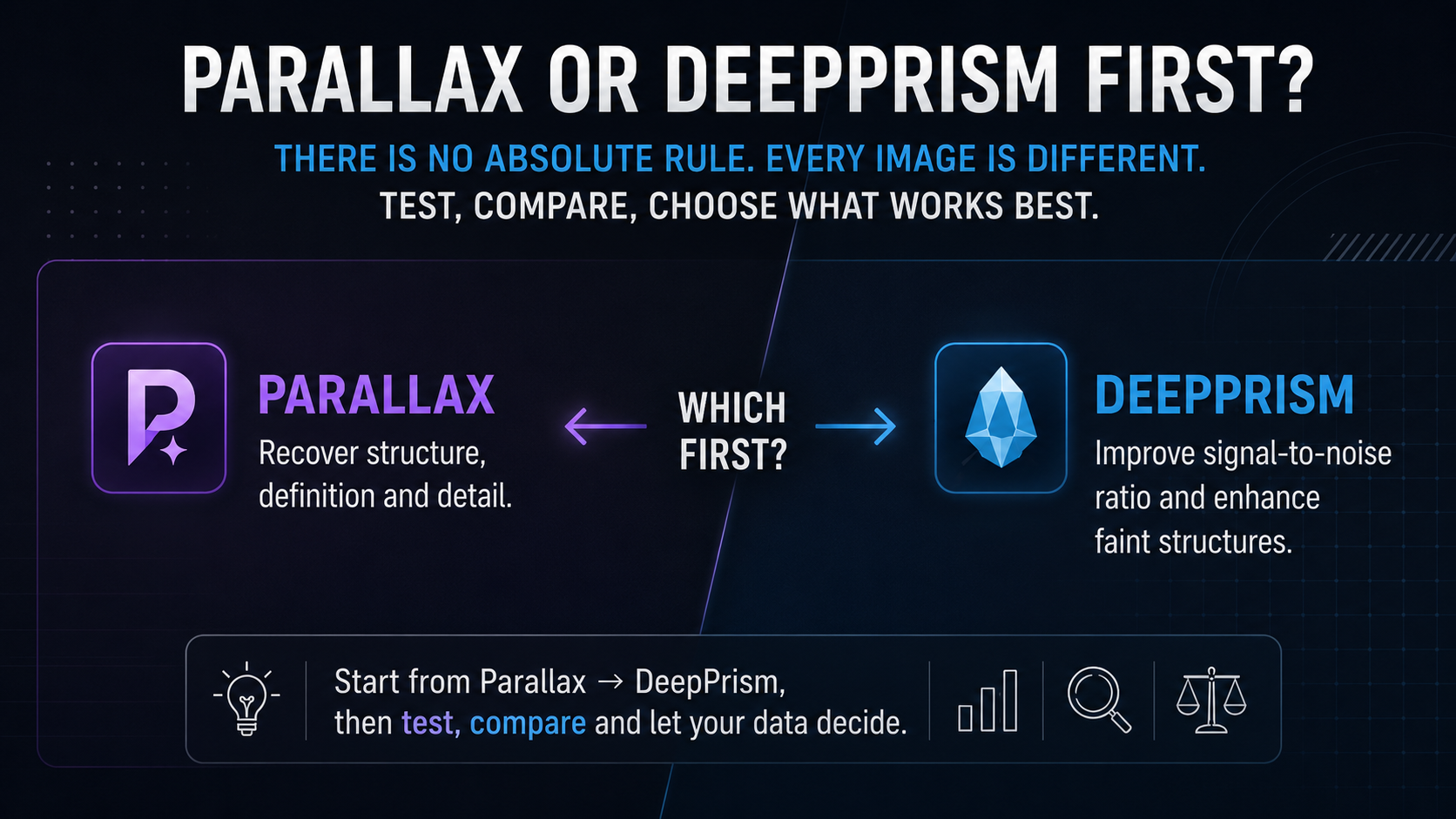
Parallax or DeepPrism first?
There is no fixed rule that works for every astronomical image.
One of the most common questions in astrophotography processing is whether it is better to apply deconvolution first or denoise first. In our case, the question becomes more specific: should Parallax be used before DeepPrism, or the other way around?
In most situations, the best starting point is:
Parallax → DeepPrism
Parallax is designed to recover structure, definition, and local detail. DeepPrism is designed to improve signal-to-noise ratio, reduce noise, and make faint structures easier to read.
So the general logic is simple: first recover structure, then clean and refine the image.
But this should not be treated as a universal law.
Every astronomical image is different. The best workflow depends on many factors: seeing, sampling, signal-to-noise ratio, optical quality, tracking, integration time, filters, camera, sky conditions, calibration, gradients, saturated stars, faint nebulosity, and possible residual artifacts.
Because of this, the best workflow is not the one that follows a formula blindly. It is the one that works best on your specific data.
Why neural tools make the answer less rigid
Parallax and DeepPrism are neural tools, and this changes the way we should think about processing order.
Unlike many traditional tools, they are designed to work across a wide range of real-world conditions. They can handle noisy images, partially processed images, sharpened images, denoised images, and data with different levels of quality and signal.
This means that, in many cases, the order is less critical than it would be with traditional processing tools.
That does not mean every sequence will produce the same result. It simply means there is no strict dependency that forces one tool to always come before the other.
The final result matters more than the rule.
Why Parallax usually comes first
Parallax is meant to work on image definition.
Its goal is to improve fine structures, local separation, compactness, microcontrast, and the overall readability of detail.
In deep-sky imaging, the real signal is always affected by atmosphere, seeing, optics, focus, sampling, tracking, and many other factors. Stars are not recorded as perfect points. Thin structures in nebulae or galaxies are not recorded with perfectly sharp edges. Everything is softened to some degree.
Parallax helps recover a more defined and coherent perception of the structures already present in the data.
It is important to understand that Parallax is not classical deconvolution.
It does not simply apply a traditional PSF-based mathematical correction. It works in a residual way, correcting and enhancing what is already in the image while staying connected to the original signal.
It does not arbitrarily invent detail. Its purpose is to recover and reinforce structure in a controlled, data-aware way.
That is why, in most cases, it makes sense to let Parallax analyze the image before a denoise process changes the texture of the data.
Why DeepPrism can sometimes come first
That said, using DeepPrism before Parallax is not automatically wrong.
A neural model works on the image it receives. If the data is extremely noisy, Parallax may have a harder time distinguishing real structure from noise texture.
DeepPrism is not just a simple smoothing tool. It is designed to improve the readability of faint signal while reducing noise. In some cases, a very light DeepPrism pass before Parallax can make the data more stable and easier to interpret.
This can be useful when the image is very grainy, the signal is weak, or faint structures are difficult to separate from the background noise.
The key word is light.
Using DeepPrism before Parallax should not mean producing a clean final image immediately. It should only reduce the most destructive noise while preserving as much fine information as possible.
If the first denoise pass is too strong, Parallax may receive an image that has already lost subtle detail or natural texture.
So DeepPrism before Parallax can be useful as preparation, but in most cases the main denoise step still makes more sense after Parallax.
A practical way to test
The recommended starting workflow is still:
Parallax → DeepPrism
But when the data is difficult, it is worth testing more than one version.
For example, compare a standard Parallax followed by DeepPrism, a lighter Parallax followed by DeepPrism, and a very light DeepPrism followed by Parallax and then another light DeepPrism pass.
When comparing the results, do not only look at the full image. Inspect the stars, the background, faint nebulosity, edges of structures, low-signal areas, and fine details.
Ask yourself whether the stars look more compact or too harsh. Check whether faint structures are clearer or artificially reconstructed. Look at the background: is it cleaner, or does it look plastic? Has the noise been reduced naturally, or has it turned into strange texture?
These observations are more useful than any fixed rule.
Practical recommendation
For most images, start with:
Parallax → DeepPrism
Use Parallax to recover structure and definition, but do not push it beyond what the data can support. If stars become too hard or artifacts appear, reduce the intensity.
Then use DeepPrism to control residual noise and improve the overall readability of the image.
The goal is not to remove every trace of noise. A perfectly smooth image is not always better. In many cases, a little natural grain looks more believable than a plastic-looking sky.
If the image is very noisy, also test a version with a very light DeepPrism pass before Parallax.
If the data is already strong, clean, and well sampled, let Parallax work early. Good data is where structure recovery can give its best results.
Conclusion
Our general recommendation is:
Parallax first, then DeepPrism.
This is usually the most logical order because Parallax works on structure and definition, while DeepPrism improves signal readability, noise control, and faint structure preservation.
Used in this order, the two tools complement each other naturally.
But there is no absolute rule.
Neural tools interpret the data they receive. If the image has been filtered too heavily, useful information may be weakened. If the image is too noisy, unwanted texture may be emphasized.
That is why the recommended order should be seen as a starting point, not a law.
In astrophotography, every image has its own behavior. The best workflow is the one that respects the data, not the one that follows a formula without looking at the result.
Start with:
Parallax → DeepPrism
Then test, compare, observe, and adjust.
The best answer is not:
“This is always how it’s done.”
The best answer is:
“This is the most sensible starting point, but the image decides.”
Discussion (0)
Join the discussion
Only registered members can write comments. Please log in or register to join this discussion.
Syncing comments...